

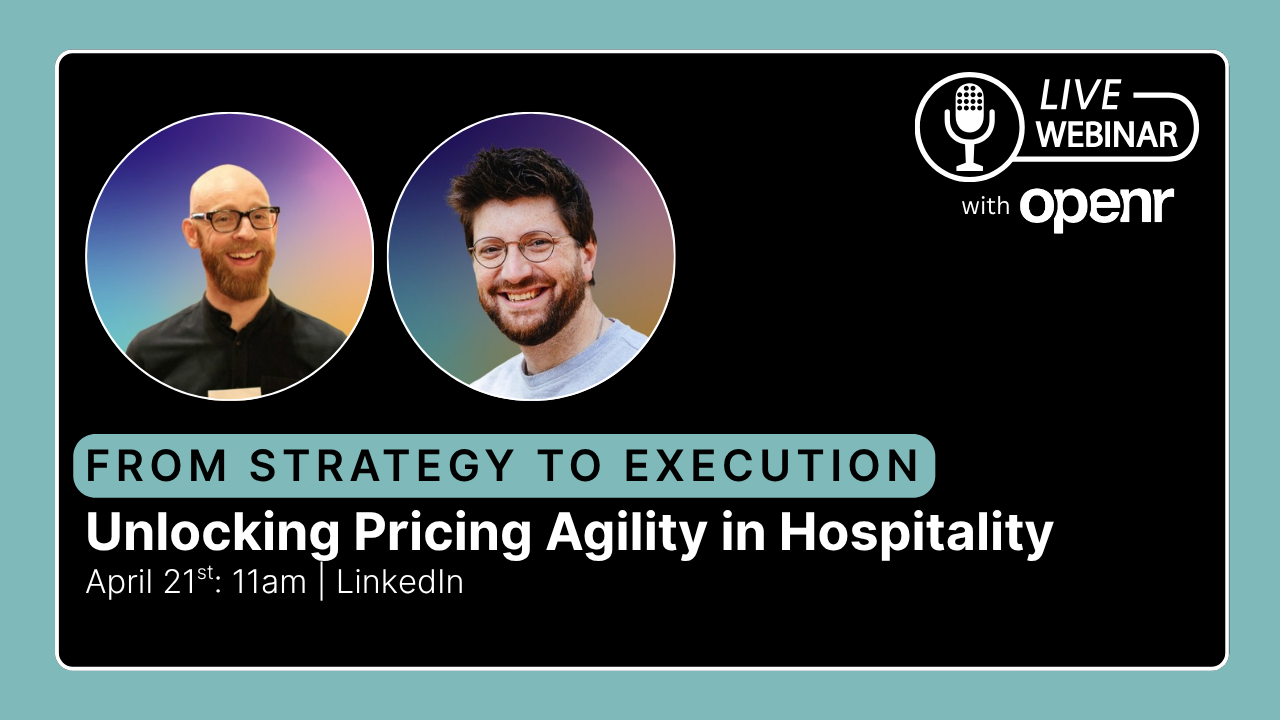
On 21st April 2025, Openr hosted a live LinkedIn webinar on unlocking pricing agility in hospitality. In it, Joel Robinson (Founder) and Nick Liddle (Chief Customer Officer) walked a live audience of operators through a practical framework for understanding where their business sits today on the pricing maturity curve, and what it actually takes to move forward. You can watch the full recording or read the key takeaways below.
Most operators have a pricing execution problem, not a pricing strategy problem.
That was the opening provocation from Joel Robinson, Founder of Openr. Here are the key takeaways from the session.
The opportunity is there. The execution infrastructure often isn’t.
Multi-site operators are sitting on hospitality’s largest untapped profit lever: agile pricing. The ability to price by demand, day-part, channel and event is no longer theoretical. The technology exists. But for most businesses, the operating model is still the barrier.
Research Openr conducted with Tech on Toast put real numbers around this. 75% of operators review pricing only one to three times per year, despite costs moving continuously. More than half estimate they’re losing between 2 and 5% of margin every year purely because of pricing delays. A single pricing change can touch ten or more separate sources of manual data entry, drifting into existence across channels over days or weeks rather than going live simultaneously.
The visible cost is the margin lost to slow execution. The less visible cost is the ideas that never get tested because the process makes experimentation too difficult.
The Pricing Maturity Model: four stages, one direction of travel
Joel introduced a four-stage diagnostic framework. It’s not a ranking system. It’s a way of making your operating constraints visible, so the next practical step becomes obvious.
Stage 1: Manual
Pricing lives in spreadsheets, updated individually across each system by different people at different times. 65% of operators still rely on spreadsheets as part of the process. Teams can spend upwards of 20 hours a month on data re-entry, with no reliable view of what’s actually live across channels. The real cost isn’t the hours spent. It’s the ideas that never get off the ground because execution feels too risky.
Stage 2: Centralised
There’s more structure here. Central ownership, approval chains, and defined price bands. It feels controlled. But deploying a single change still requires coordinating across three or more teams and systems, and the overhead means anything experimental never really gets off the ground. Smart modelling happens in spreadsheets outside core systems. As one finance director told Joel, the strategy is running ahead of the infrastructure.
Stage 3: Connected
This is where things change meaningfully. Pricing and menu data live in one place and flow out to every channel automatically. Hours, not days or weeks. The more important shift isn’t the speed. It’s what fast, reversible execution does to team behaviour. Trials stop feeling like gambles. Teams stop defaulting to estate-wide changes out of caution and start running targeted experiments that actually tell them something.
Stonegate is the clearest illustration. Before Openr: four price changes a year across 1,500 venues, taking four to six weeks end-to-end. Today: over 30 per year, per product, per venue, with different strategies running simultaneously across the estate. Their ambition didn’t change. What changed was that execution stopped being the reason not to act.
Stage 4: Optimised
Pricing becomes a continuous commercial capability rather than an occasional exercise. The business runs experiments, reviews the data, and rolls out or pulls back based on evidence from its own estate, not industry benchmarks or gut feel. One operator put it plainly: if you run twelve pricing experiments in six months and four drive growth, four make no difference, and four move sales backwards, you’ve learnt twelve things. The advantage isn’t the pricing itself. It’s the pace of learning.
Where most operators sit today
Most businesses are sitting between stages one and two. The commercial intent is real. The ideas exist. What’s missing is the operational foundation to act at a pace that makes learning possible. Without it, even a good strategy underperforms.
The research number that matters most isn’t the 2 to 5% of margin being lost to pricing delays. It’s the number you can’t see on a P&L: the experiments that never ran, the trials that never got set up, and the cumulative commercial knowledge that never got built.
The World Cup 2026: a live, time-pressured version of the same problem
The second half of the session used the 2026 World Cup as a practical lens. Six weeks of sustained demand, more fixtures than ever, and England and Scotland both involved. But not all fixture days are equal. Euro 2024 data showed pubs and bars saw a 9% uplift on home nation match days and a 4% decline on others.
England and Scotland fixtures draw different audiences, different dwell times and different ordering behaviour. The delivery channel, in particular, is the most commercially interesting channel to activate differently by fixture, without creating any friction for the customer.
The execution problem: 60% of operators take more than a week to get a price change live. That effectively closes the window before it opens. Euro 2024 showed that operators who couldn’t move fast absorbed the volume without capturing the margin that came with it.
Where you sit on the maturity model determines what the tournament is worth to you commercially:
- Stages 1 and 2: you trade on volume alone, by default rather than design
- Stage 3: fixture-specific pricing and delivery menus go live quickly, per venue, without a separate deployment exercise for each channel
- Stage 4: The tournament becomes a six-week compounding learning opportunity, with each round of games informing the next
Key takeaways
- Most operators have a pricing execution problem, not a pricing strategy problem. The ideas exist. The infrastructure to act on them quickly doesn’t.
- 75% of operators review pricing only one to three times per year. More than half are losing 2 to 5% of their margin annually due to pricing delays.
- The four-stage maturity model (Manual, Centralised, Connected, Optimised) is a diagnostic, not a ranking. Understanding where you actually are is the starting point.
- The unlock is stage 3: connected infrastructure that makes execution fast and reversible. That changes what teams are willing to attempt.
- The real commercial advantage isn’t in the pricing itself. It’s in the pace of learning that connected execution makes possible.
- The World Cup 2026 is a live test of your pricing maturity. Operators at stage 3 or above can run fixture-specific strategies. Those at stage 1 or 2 will trade on volume alone.
- Sophisticated pricing technology cannot be bolted onto fragmented manual systems. The execution foundation has to come first.
Want to know where your business sits on the pricing maturity model? Take the Pricing Agility Audit or get in touch with the Openr team.
Book a Pricing Agility Audit with Nick Liddle here.